01Which box template to use
| Template | What it is | Usual board | Use it for |
|---|---|---|---|
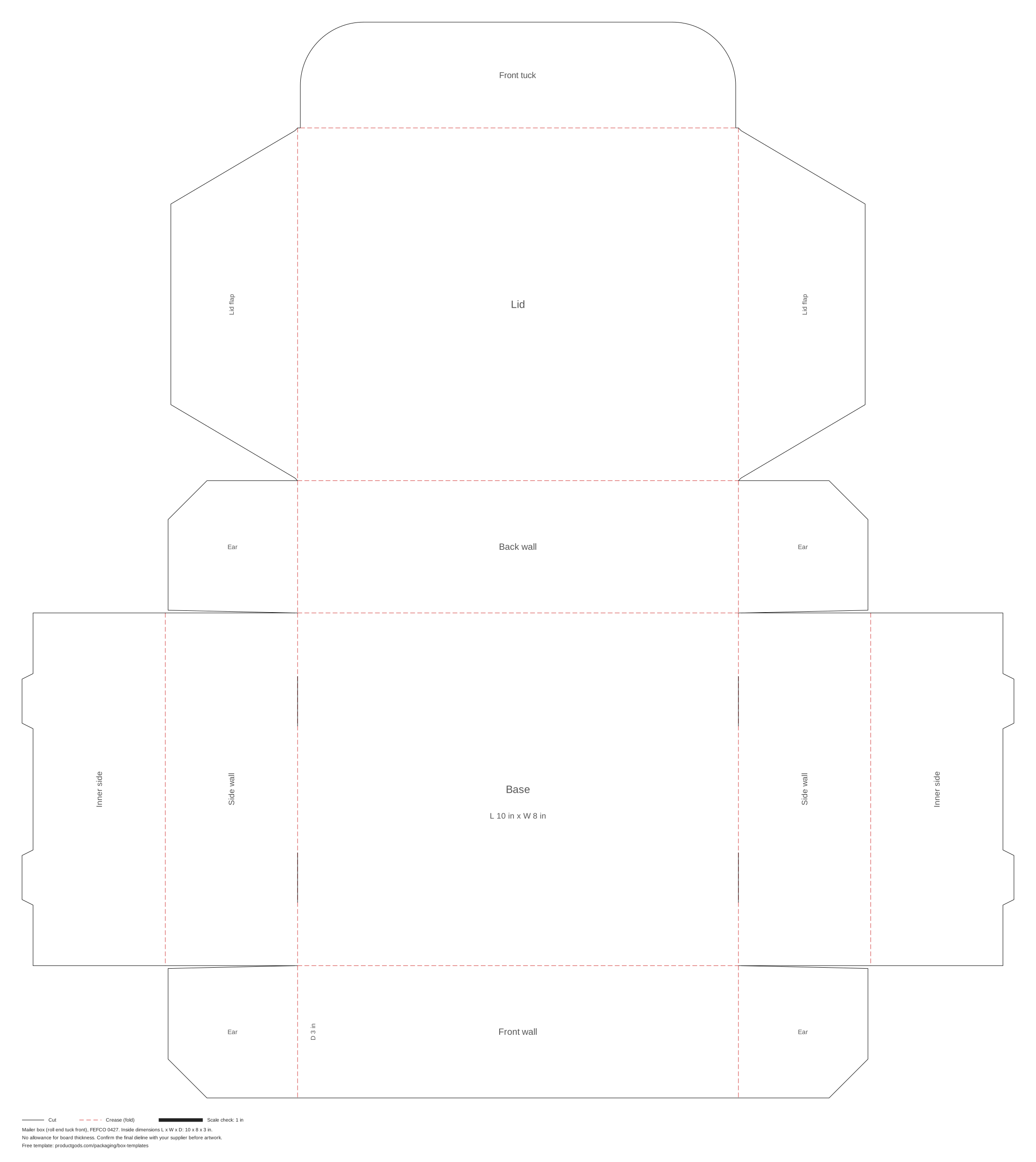
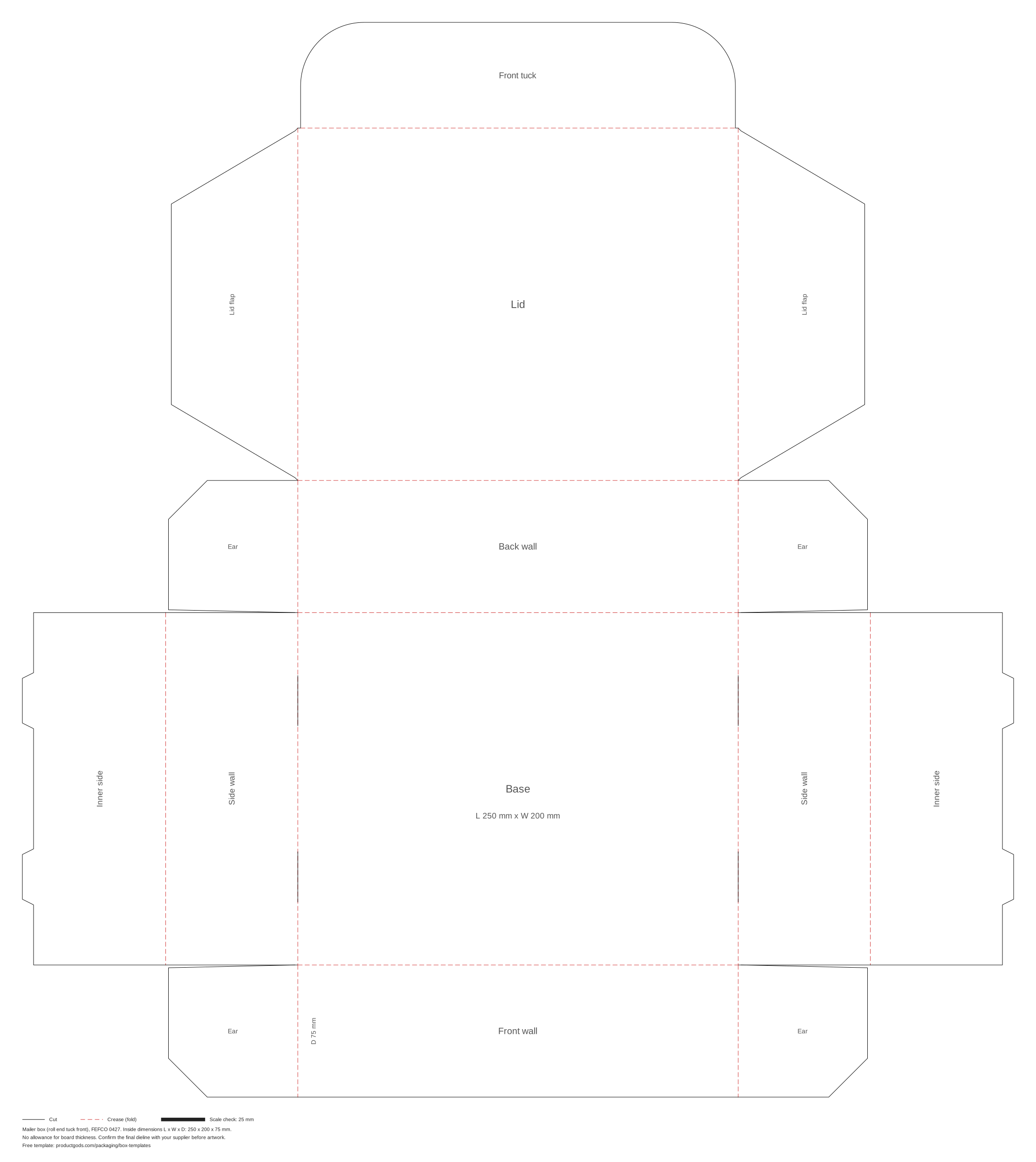
| Mailer box (roll end tuck front) | One piece: rolled double side walls, hinged lid, front tuck | Corrugated board (ask which flute) | DTC shipping, subscription and PR boxes that are opened on camera |
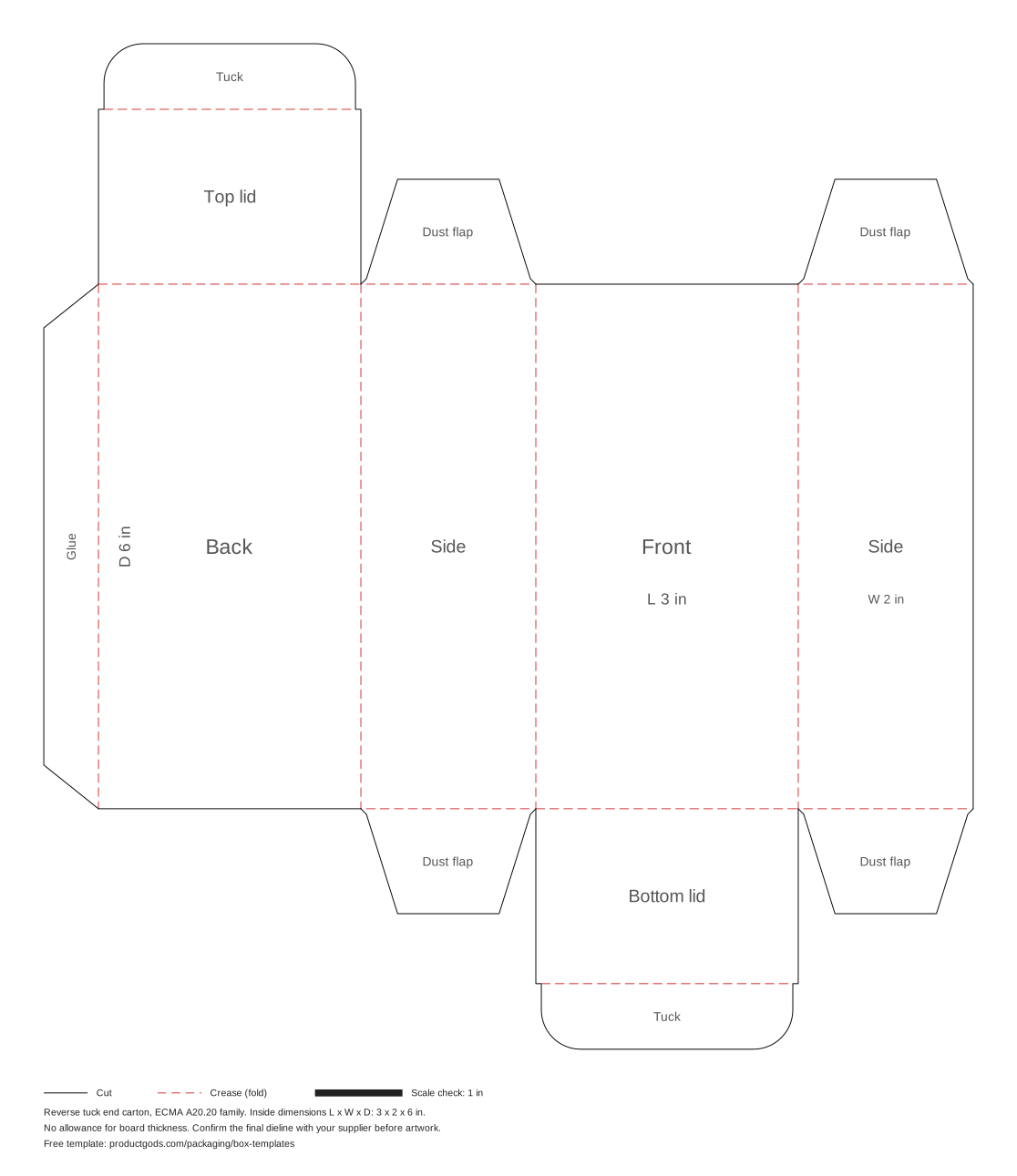
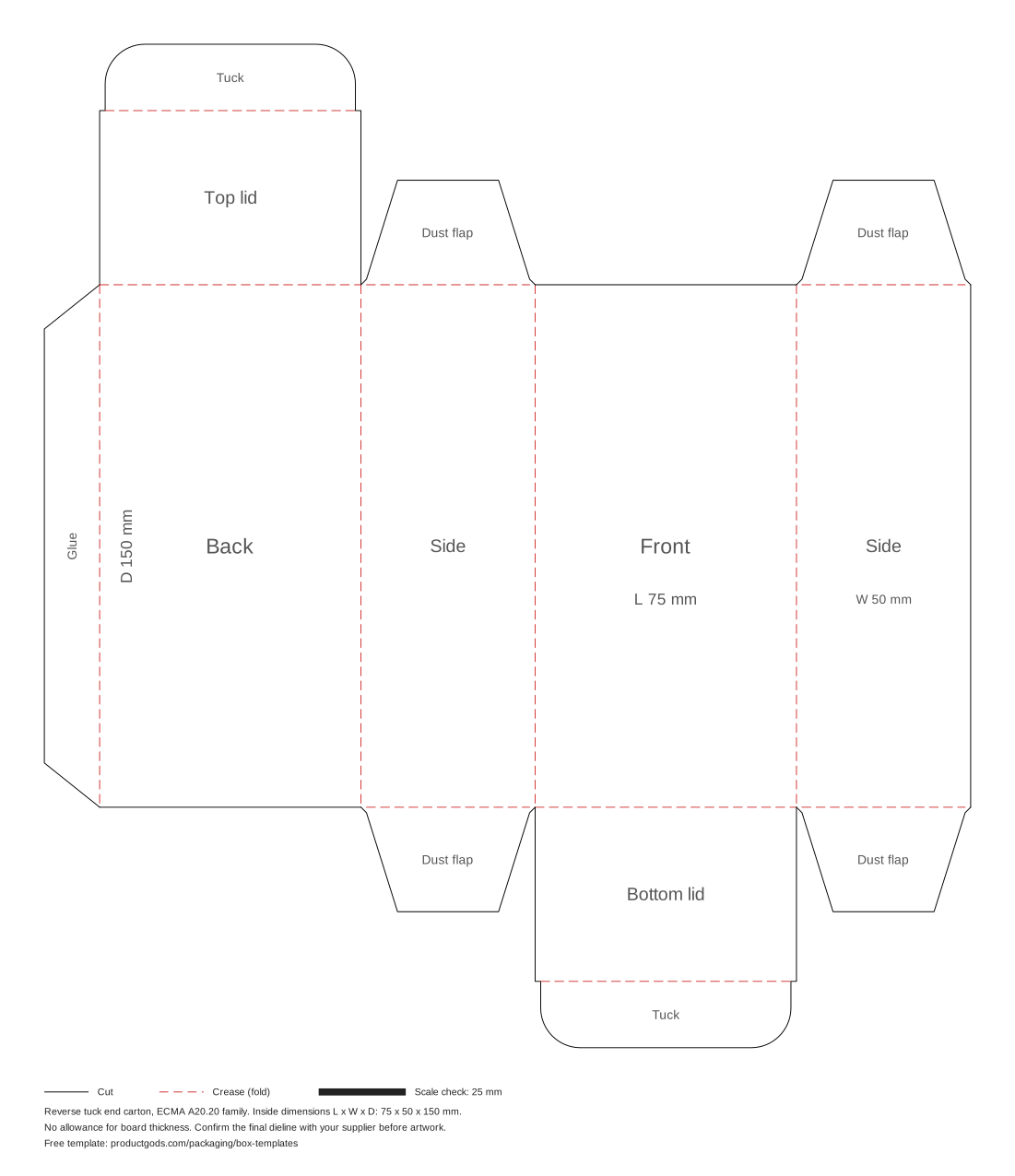
| Reverse tuck end carton | Top tuck hinges on the back panel, bottom tuck on the front | Paperboard (SBS, CUK or recycled CRB) | Retail cartons for cosmetics, supplements, candles, small electronics |
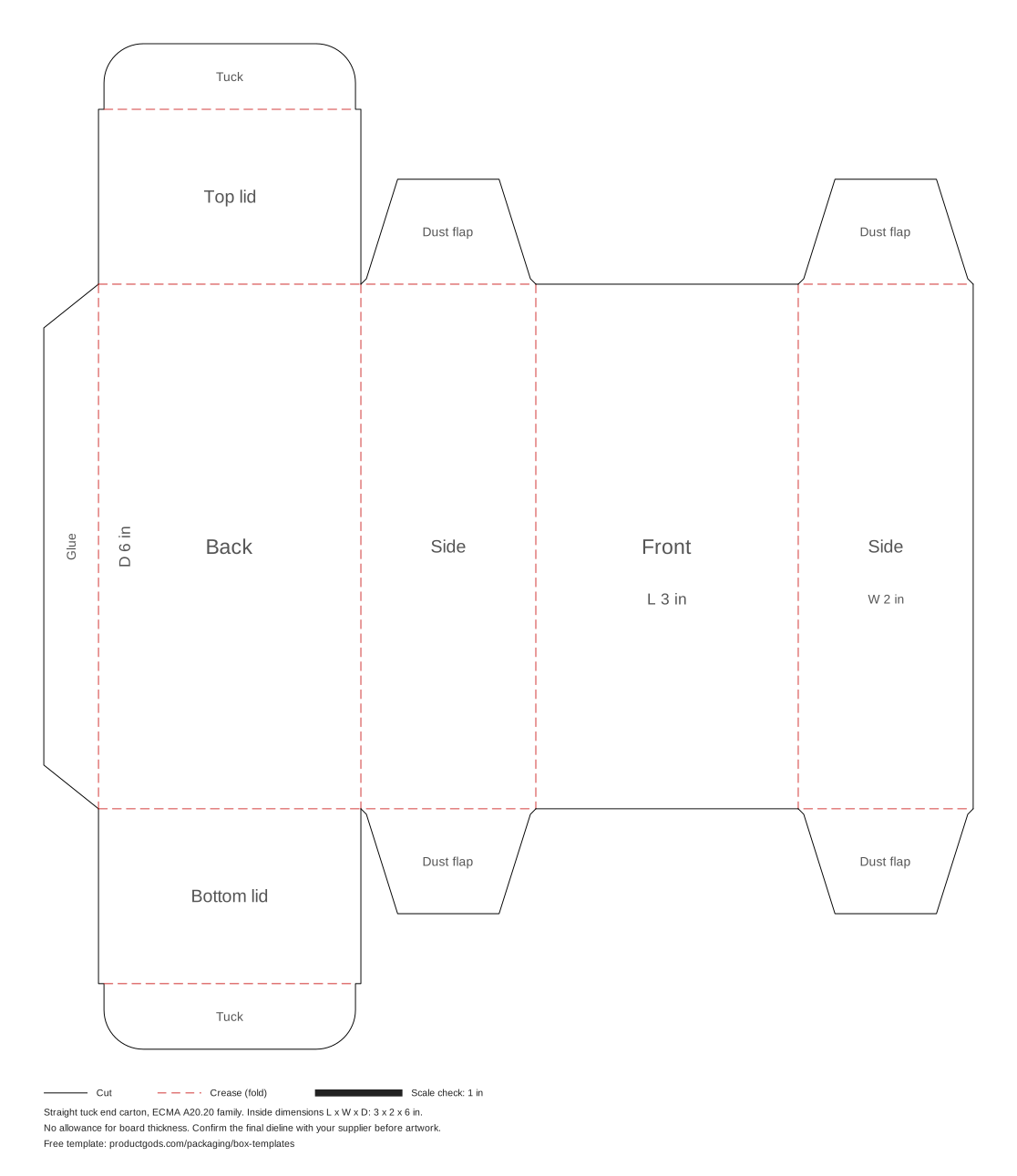
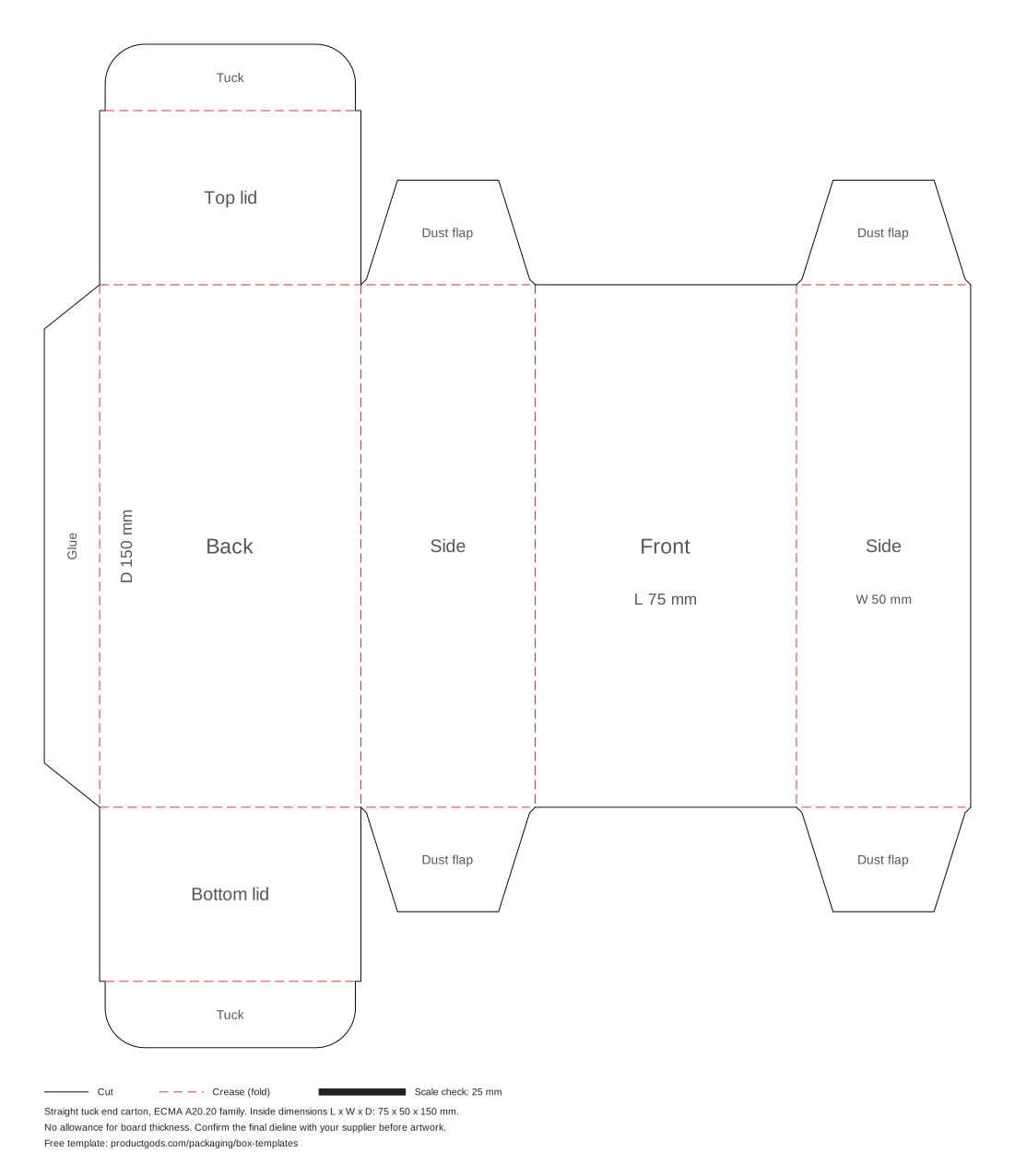
| Straight tuck end carton | Both tucks hinge on the back panel | Paperboard (SBS, CUK or recycled CRB) | Cartons where the front panel must print as one clean face |
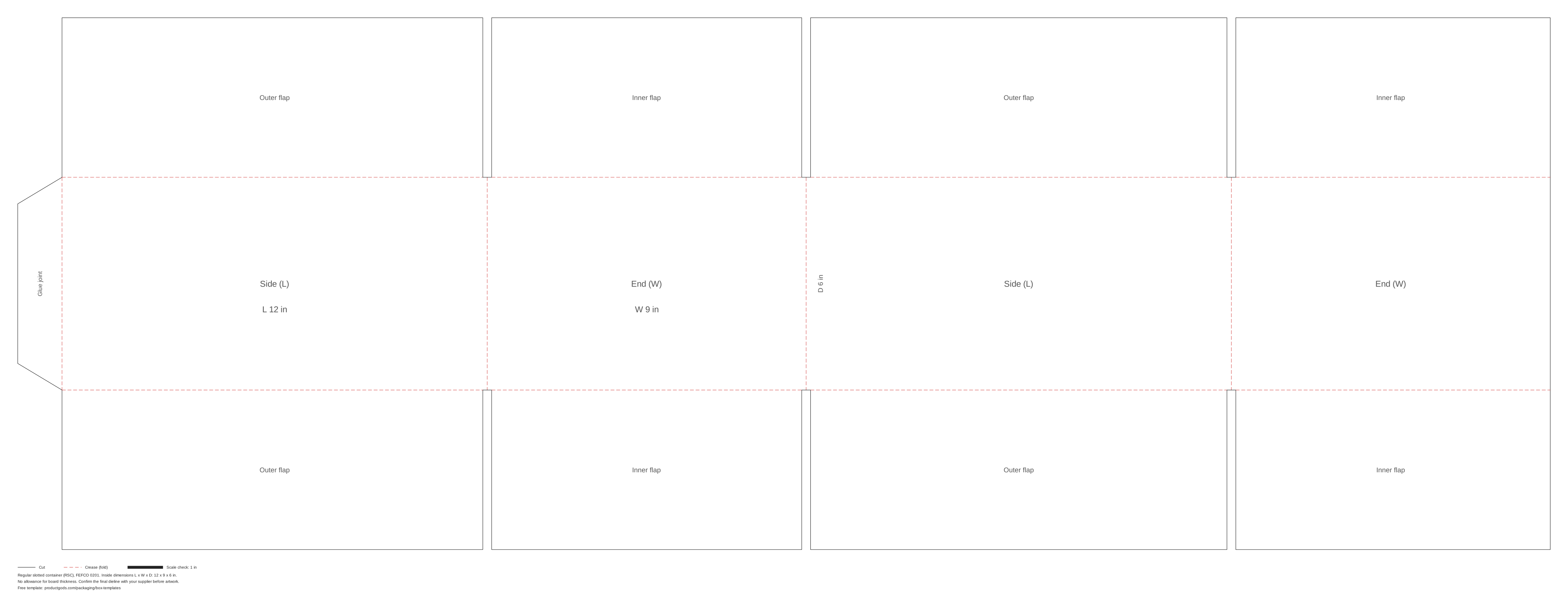
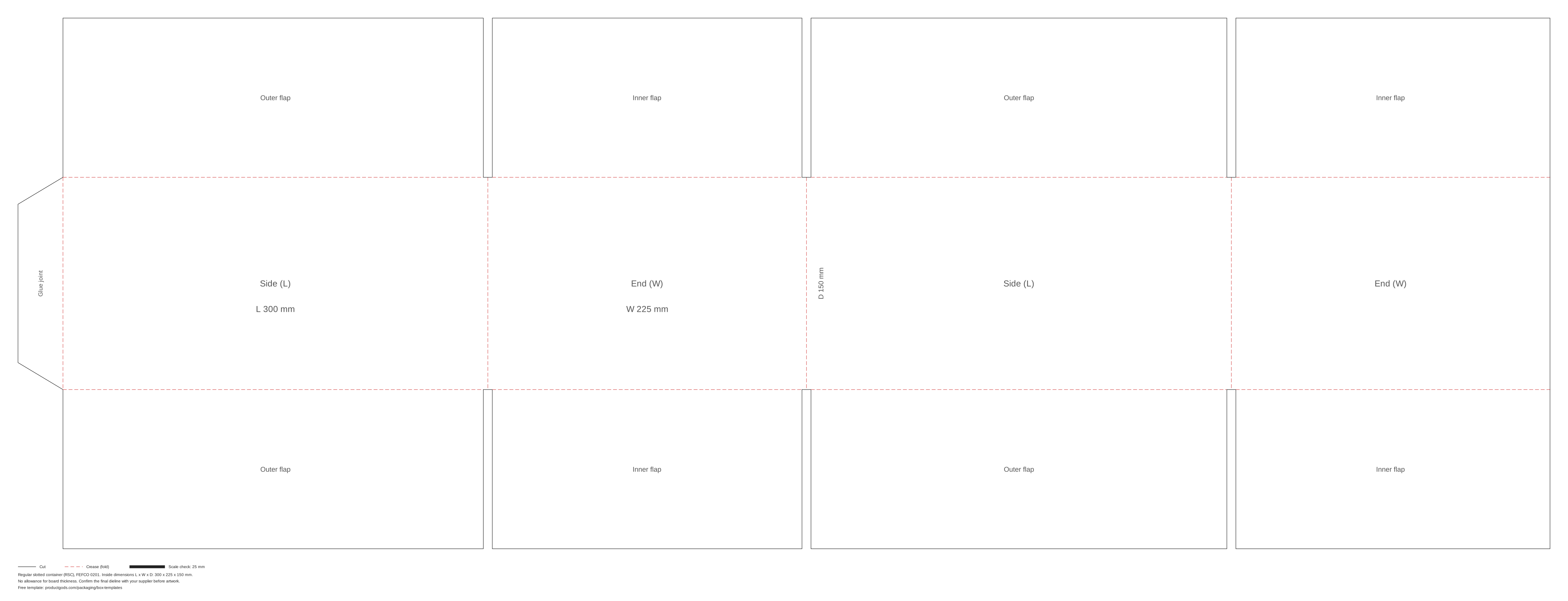
| Regular slotted container (RSC) | Four panels, glued joint, all flaps half the width so the outer flaps meet | Single or double wall corrugated | Shipping cartons and master cartons |
Not sure between a mailer and a carton? A mailer is a shipping box: it goes through the mail on its own. A tuck end carton is a retail box that sits on a shelf and usually ships packed in a corrugated case. See mailer boxes, folding cartons and corrugated boxes for the materials and costs behind each.
02How to use the templates
- Measure the inside space your product needs: length (the longer side of the opening), width (the shorter side) and depth. Box sizes are quoted as inside dimensions, in that order.
- Pick the style, choose inches or millimeters and type the three numbers. The preview redraws as you type. The starting sizes are round numbers for a first paper model, not standard sizes.
- Download the PDF to print and fold a paper mockup, or the SVG to open in your design software. Both are full size; check the scale bar measures 1 inch (or 25 mm) after printing.
- Put your artwork on its own layer above the template, extend background art past the cut lines, and keep text away from folds.
- Before you pay for printing, ask your supplier for their dieline in your size and board, and move your art onto it.
Printing on a home printer? Large boxes won't fit a letter or A4 sheet at full size. Print at "fit to page" for a scaled paper model; the proportions hold, only the size changes.
03What the lines and labels mean
| Mark | Meaning |
|---|---|
| Solid black line | Cut: the outline and the slots between flaps |
| Dashed red line | Crease: fold here |
| Panel names | Front, back, side, base, lid, tuck, dust flap, ear and glue flap, so you know which face is which once folded |
| L, W and D values | The inside dimensions you typed, printed on the panel they set |
| Scale check | A 1 inch or 25 mm bar to confirm the file printed at full size |
There is no single industry color code for dieline lines. Printers each send their own legend, and FEFCO, the European corrugated standard, identifies lines by code rather than color. Our colors are a common choice, not a rule. More on line types in what is a dieline.
04Why your supplier's dieline still wins
A template is drawn with zero board thickness. Real board takes up space at every fold: the inside of the fold loses some length and the outside gains it, and the scoring allowance depends on the board's caliper (The Packaging School). An E flute mailer and a thin paperboard carton of the same inside size need different panel sizes, and only the converter knows the exact board and their machines.
Use these templates to decide size and style, test-fold a paper model, brief a designer and get comparable quotes. Then ask the supplier for their production dieline and have your designer place the final art on that file. If you are sourcing the boxes overseas, our packaging manufacturer list shows factories by country, and The Vault in the Product Sourcing Secrets course has their contacts.
05How to spec it with a supplier
When you send a template to a box supplier for a quote, add the lines a template can't carry.
| No. | Field | What to write |
|---|---|---|
| 01 | Style | The style name and code from the template (for example FEFCO 0427 mailer) |
| 02 | Inside dimensions | L x W x D, and whether that is inside (it should be) |
| 03 | Board | Flute and board grade for corrugated, caliper or GSM for paperboard |
| 04 | Outside, inside or both; number of colors; any finish | |
| 05 | Quantity | Two quantities, so the unit price at scale is visible |
| 06 | Dieline request | Ask for their production dieline in your size as a vector PDF or AI file |
Questions to ask the supplier
- Will you send your dieline for this size and board before we finalize artwork?
- Do you charge for the cutting die, and do we keep it for reorders?
- Can you send a plain, unprinted sample in this size first?
06FAQ
Q01Where can I get a free box template?
On this page: a mailer box, reverse tuck end, straight tuck end and RSC shipping box, in any size, as SVG or PDF, with no sign-up.
Q02How do I measure a box for a template?
Measure inside dimensions: length (longer side of the opening), width (shorter side), then depth. That is how box sizes are quoted.
Q03What is the difference between a reverse tuck and a straight tuck box?
On a reverse tuck end carton the top and bottom tucks hinge on opposite panels. On a straight tuck end carton both hinge on the same panel and tuck the same way, so the front stays one clean face.
Q04Can I send this template to a printer?
Use it to brief and quote. For production, ask the printer for their dieline in your size and board, because it includes allowances for board thickness that a template doesn't.
Q05What is FEFCO 0201?
The code in the FEFCO Code (the European corrugated box style standard) for the regular slotted container: four panels with a joint and flaps top and bottom, the everyday shipping carton.